



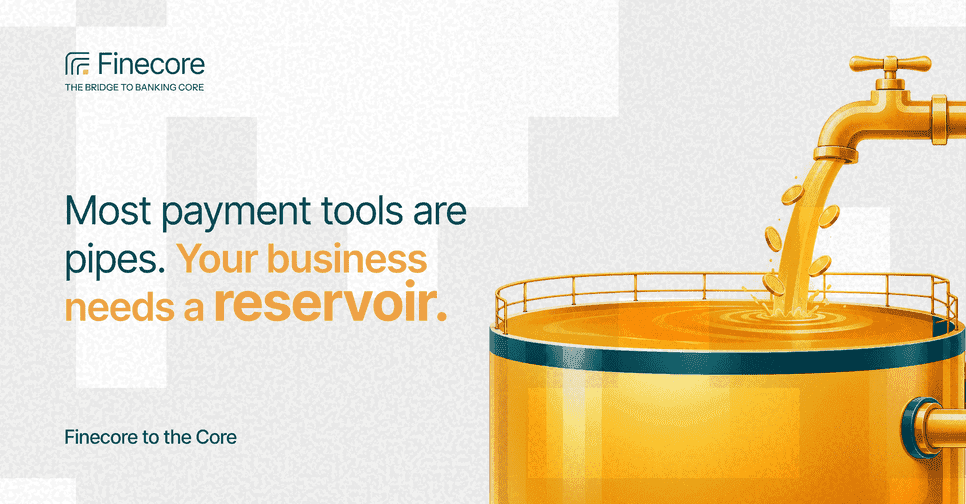
Your Payment Stack Is a Pipe. Your Business Needs a Reservoir.
Most payment tools move money from A to B. Enterprises operating across fragmented markets need to hold, record, convert and release it. Here is why.
Key takeaways before you dive in…
- A pipe moves money. A reservoir holds it, records it, converts it and releases it when you decide.
- Nigeria's instant-payment rail processed nearly 11 billion transactions in 2024, and the central bank has since told acquirers and processors to connect to two switches, not one.
- Public benchmarks put the gain from smart routing between about 2 and 12 percentage points of approval rate, depending on the starting point. Cross-border cards start lower.
- Capital in transit = daily volume × settlement days. Most finance teams have never calculated it.
- Finecore is built as a reservoir: money lands in named multi-currency accounts, converts on your schedule, and leaves through local payout or stablecoin routes, through one dashboard or one API.
The regulator already said it On December 11, 2025, the Central Bank of Nigeria directed every acquirer, processor and payment terminal provider to connect to two switches instead of one: NIBSS and UPSL. The system at the centre of that order had handled nearly 11 billion instant payments in 2024, worth about ₦1.07 quadrillion. A regulator does not mandate redundancy for something that never breaks.
It breaks. In 2024, downtime at NIBSS left transactions failing across instant transfers, internet banking, POS and ATMs for roughly three days. The rail itself is also changing: NIBSS has begun rolling out a new National Payment Stack designed to succeed the 15-year-old instant-payment system.
That is the situation most African enterprises are building on. The last decade of fintech laid pipes: APIs that connect a business to a bank or a card network, and a checkout that works. That work mattered. It brought millions of businesses online. But a pipe has one design flaw. Nothing stays in it. Money passes through, and everything that matters to a CFO or CTO happens before it enters or after it leaves.
The systemic illusion
A pipe-only payment stack looks fine in a demo and in a monthly report. It shows up as cost in four places:
Transaction drops. One provider, one route. When it degrades, customers see failures and your team sees tickets. Single points of failure. If your collection, payout and settlement all depend on one rail, one outage touches all three. Capital in transit. Money you have earned sits in someone else's settlement cycle. You can't pay a supplier with it, convert it, or invest it. No downstream visibility. You know a payment was sent. You can't easily say where every unit of money is, in which currency, right now.
The visibility problem is widespread. In a Mangopay survey of enterprise platforms (April 2026), reconciliation was mostly manual for 50% and fully manual for another 36%. In a separate UK survey, 39% of companies said they only see foreign-exchange costs after settlement.
These are not edge cases. They are the normal state of a business whose payment stack was built to move money, not to hold it.
The reservoir paradigm
A reservoir does four things a pipe doesn't:
It holds money in the currency you choose, in an account you control. It records every movement in one set of books. It converts on your schedule, not on a deadline imposed by a settlement cycle. It releases funds, locally or across borders, when you decide.
Pipes optimise for the transfer. Reservoirs optimise for the balance sheet.
What Finecore has built so far
Finecore is financial infrastructure that companies use to launch financial products, and that businesses use for their own operations. Today that means:
- Accounts: named multi-currency accounts for businesses in 26+ currencies, and virtual accounts for individuals (USD, GBP, CNY, PHP, AUD, SGD, DKK, AED, CAD, NGN). A Nigerian exporter can share GBP account details with a UK buyer, receive GBP, and decide when to convert or move it.
- Collection: Global Collection helps businesses collect from customers in 70+ countries using local methods where available. PayIn lets a customer pay in local currency (for example NGN, GHS, KES or GBP) while the merchant receives USD or a stablecoin.
- Release: PayOut converts from USD or a stablecoin and pays out in local currency to local bank accounts or available local methods.
- Digital assets: stablecoin on-ramp and off-ramp journeys through an API.
- Identity: embedded KYC and KYB through an API (Nigeria today).
Two doors: the Finecore Business Dashboard for businesses, and the Finecore API for platforms.
Availability depends on currency, market and route.
- Transaction resilience: build for the day a rail stops A pipe is only as reliable as its weakest link. For a business that collects through one route and pays out through another, that means every outage is your outage.
Nigeria is a clear case study because the data is public. NIBSS instant payments account for the large majority of cashless transactions. When it slows, everyone slows. That is why a regulator ordered dual connectivity and why the rail itself is being replaced.
A reservoir changes the design question from "Which provider is best?" to "What happens to this payment when that provider stops?" Three tests apply to any provider, including us:
Which rails does each route depend on, and are there alternatives? What state is a payment in when a rail fails mid-flight, and can I see it? Where does the money sit while the problem is fixed?
- Capital velocity: the number your finance team has never calculated Capital in transit = monthly volume ÷ 30 × days of settlement delay.
A business moving $3M a month with a 3-day settlement delay always has about $300,000 in motion. On cross-border payments, public estimates put traditional settlement at 3 to 5 days. At $1M a month, that is $100,000 to $167,000 that can't be used for payroll, supplier deposits or currency decisions.
A reservoir attacks this from two sides. Funds land in an account you control (a named account in the currency your buyer uses), and the decision to convert or move them becomes yours. Stablecoin routes can shorten the middle of a cross-border journey, though the on-ramp, off-ramp and the rules in each country still matter. Nigeria accounts for about 60% of sub-Saharan Africa's stablecoin inflows since 2019 (IMF, June 2026). Businesses are already moving this way.
- Data and reconciliation: one set of books Pipes give you webhooks, bank statements and provider reports. Matching them is a job people do on spreadsheets every month-end. The more currencies, rails and entities, the worse it gets, and 86% of platforms in the Mangopay survey still do it largely by hand.
A reservoir treats the ledger as the foundation. In a double-entry ledger, every movement is recorded as a debit in one account and an equal credit in another, and entries can't be edited after the fact. The result is a single source of truth: any balance can be explained by the entries that made it.
What this does for a finance team:
Every payment, conversion and payout is tied to an account, a currency and a status. Month-end becomes verification, not detective work. An auditor can trace any number to the entries behind it.
The market: collection solved, now comes custody Collection-first platforms solved a real problem. Fintechs made it possible for African businesses to accept payments online at scale. They are also moving down the stack: Globally, orchestration and payout platforms are connecting banks and local methods across dozens of countries.
The pattern is clear. The industry is moving from accepting money to owning the layer beneath it: accounts, ledgers, currencies and licences. For an enterprise, this raises a question that has nothing to do with brand: who sits under your money, and what happens to your flows if their strategy changes?
Finecore's answer is a deliberately focused one:
Cross-border and multi-currency first, rather than domestic acceptance first. Local routes in and out, so customers pay and recipients are paid in their own currency where available. Two doors on one foundation, so a business and a platform can share the same infrastructure.
How a reservoir works under the hood Layer 1: The core ledger The bedrock. A double-entry, append-only record of every balance and movement, by account and currency. Everything else reads from it.
Layer 2: Orchestration and routing The logic that decides which route a payment takes: based on cost, speed and real-time rail health. When one rail slows or fails, the system falls back to another or holds the payment in a known state, instead of dropping it.
Layer 3: Programmable money Rules that move money without a trip to an external bank: escrow (hold until a condition is met), split payments for marketplaces (one customer payment divided among several recipients) and scheduled vendor payouts. These are where a reservoir stops being storage and becomes a working engine.
What it's worth: a CFO's model The honest way to quantify this is to measure your own numbers. Here are the public benchmarks and the arithmetic.
Approval rate
Public benchmark: Smart routing typically lifts approval by about 2 to 4 points; vendor-reported averages are around 8 points; cross-border cards usually run 5 to 15 points below domestic rates
What it means for you: If you attempt $10M of card payments a month, each point is $100K. A 4-point gain is $400K a month
Capital in transit
Public benchmark: Smart routing typically lifts approval by about 2 to 4 points; vendor-reported averages are around 8 points; cross-border cards usually run 5 to 15 points below domestic rates
What it means for you: Money you can use sooner, or stop borrowing against
Reconciliation effort
Public benchmark: 86% of surveyed platforms reconcile mostly or fully by hand
What it means for you: Hours × loaded cost of every analyst who matches payments
FX visibility
Public benchmark: 39% of UK firms see FX cost only after settlement
What it means for you: The size of the spread you aren't measuring
Three measurements to take in 30 days: Approval rate by route, currency and payment method. Average days from customer payment to usable funds. Analyst hours spent on matching and exceptions each month.
We do not promise outcomes. Results depend on your markets, mix and starting point. What a reservoir offers is the ability to see these numbers and act on them.
Questions CFOs and CTOs ask What is a payment reservoir? A payment reservoir is an architecture that holds, records, converts and releases money in accounts you control, instead of only routing it from sender to receiver. How is it different from a payment gateway? A gateway moves a payment through a route. A reservoir adds the accounts, ledger and currency control around that movement, so funds can rest and be directed. Why does this matter in Nigeria and across the world? Because rails, currencies and rules vary by market, and a single rail failure or settlement delay has a direct cost. The CBN's dual-connectivity directive is a public example. Where do stablecoins fit? They can shorten the middle of a cross-border payment, but getting money in and out, and following each country's rules, remain essential. Rules differ by country and are changing. What should I ask a provider? Which rails each route depends on, what happens to a payment when one fails, where my money sits, how every movement is recorded, and which countries and currencies are actually available.
Where to start Bring us your three most important payment routes, the currencies involved and the settlement delay on each. We'll show you what could be held, converted or released differently, and tell you honestly where a route isn't available.
finecore.co | comms@finecore.co
Sources CBN circular of Dec 11, 2025 on dual connectivity (BusinessDay, "How Nigeria's N13.66bn payment error still haunts NIBSS") NIP volume and value for 2024 (CBN Fintech Policy Analysis Report, Feb 2026, via TechCabal; NIBSS via Nairametrics) NIBSS downtime (The Guardian); National Payment Stack (AllAfrica, Aug 2026) Mangopay platform survey (Apr 2026); UK payments survey on FX visibility (CFOtech UK, Apr 2026) Smart-routing benchmarks: Gr4vy (2026), Yuno (2026, vendor-reported), Trio Cross-border settlement time of 3 to 5 days: Brookings (Aug 2026) Nigeria 60% stablecoin inflows: IMF via PYMNTS (June 2026) Paystack–Ladder and Flutterwave–Mono (TechCabal, Techeconomy); Flutterwave–Nuvion stablecoin wallets (BusinessDay) Finecore product facts: Finecore Team Product Guide
Stay Fine to the Core. Join the conversation on social media:
LinkedIn | Instagram | X (Twitter)
Written by Victoria Pabiekun
Communications & Marketing Associate, Finecore