


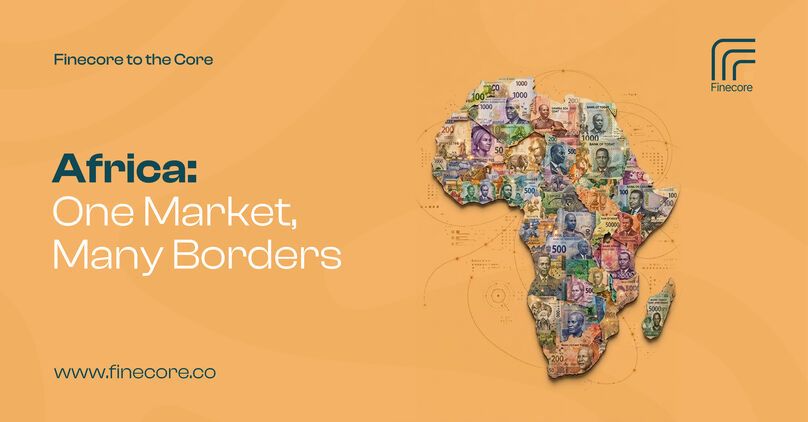
Africa: One Market, Many Borders
The air in the boardroom was thick, not just with the heat of a Lagos afternoon, but with a tension that only a "pending" transaction can create. A local manufacturer had 48 hours to settle a supplier in Nairobi for raw materials. The funds were ready. The intent was there. But as the clock ticked, the money was stuck in a digital "no-man's-land" between two neighboring countries. It wasn’t a lack of cash, but a lack of a bridge. By the time the transaction cleared four days later, the supplier had sold the stock elsewhere, and the factory floor went silent.
Another scenario… The plane touched down in Accra at 8:00 PM, but the money was also stuck in a digital "no-man's-land" somewhere over the Atlantic. There was a vendor standing in a warehouse in Tema, crossing his arms. He didn't care about "correspondent banking networks" or "SWIFT settlement windows." He cared that his screen showed a balance of zero, while the sender in Lagos was looking at a "Transaction Successful" receipt. In African trade, that gap, that silent, terrifying space between sent and received is where businesses go to die.
This is the quiet heartbreak of doing business in Africa. We often talk about Africa as a single, massive market of 1.4 billion people. It’s a beautiful vision. But for anyone who has actually tried to move value across a border, the reality is a jagged landscape of 54 different regulatory "walls," dozens of fluctuating currencies, and a legacy banking system that often feels like it was designed to keep us apart rather than bring us together.
The $50 Billion Friction
The statistics tell a story of immense missed opportunity. Intra-African trade currently sits at around 15-18%, compared to nearly 60% in Asia and 70% in Europe. Why? Because it is often cheaper and faster to settle a payment from Lagos to London than it is from Lagos to Nairobi.
The "hidden tax" on African business isn't just the 5-7% remittance fee; it’s the Time-to-Settlement. When capital is locked in transit for three to five business days, it’s "dead money." For a business operating on thin margins, five days of dead money is the difference between restocking for the week or closing the doors.
The "Shadow" Borders
If you look beyond the physical checkpoints, there are the digital borders. I’ve seen brilliant engineering teams build what they thought was a "global" payment app, only to watch it crumble the moment it hit the specific liquidity constraints of a neighboring country.
The mistake is treating every border like a tech problem. It’s not. It’s a Logic and Trust problem. Every central bank has its own "language." Every local market has its own "behavior". If your infrastructure doesn't speak those languages natively, you aren't building a bridge; you’re just shouting into a void.
The Breaking Point
I remember sitting with a founder who had just lost a six-figure B2B contract. The reason? A reconciliation error that took four days to find because the “connect” between the two countries were so opaque that neither side knew where the funds were. That’s the "Error 404" of cross-border trade.
Now, let’s build the Bridge...
The future of the African market won't be won by the flashy front-end apps. It will be won by the people building the "systems" - the infrastructure that treats a cross-border transaction with the same simplicity as a local wallet transfer. This requires moving away from the "Human API" model where staff spend their weekends manually reconciling cross-border sheets, and moving toward an Infrastructure Culture. We need systems that provide real-time visibility, automated B2B liquidity, and the ability to settle in stablecoins or local currency without the legacy "red tape".
The Finecore Fix: At Finecore, we don't believe in digital walls. We build the "sensory system" for African finance - an embedded banking infrastructure that allows businesses to scale across borders without feeling the friction. Be it cross-border payments, stablecoin, or a core that handles multi-currency logic natively, we ensure that when you see "One Market," your tech sees the same thing.
The map is being redrawn by code that refuses to blink. Don't let your business get lost in the gaps.
Build for the future. Build to the Core. finecore.co
Stay Fine to the Core. Follow the journey: LinkedIn | Instagram | X (@finecore)
Written by
Victoria Pabiekun
Marketing & Communications Associate, Finecore