


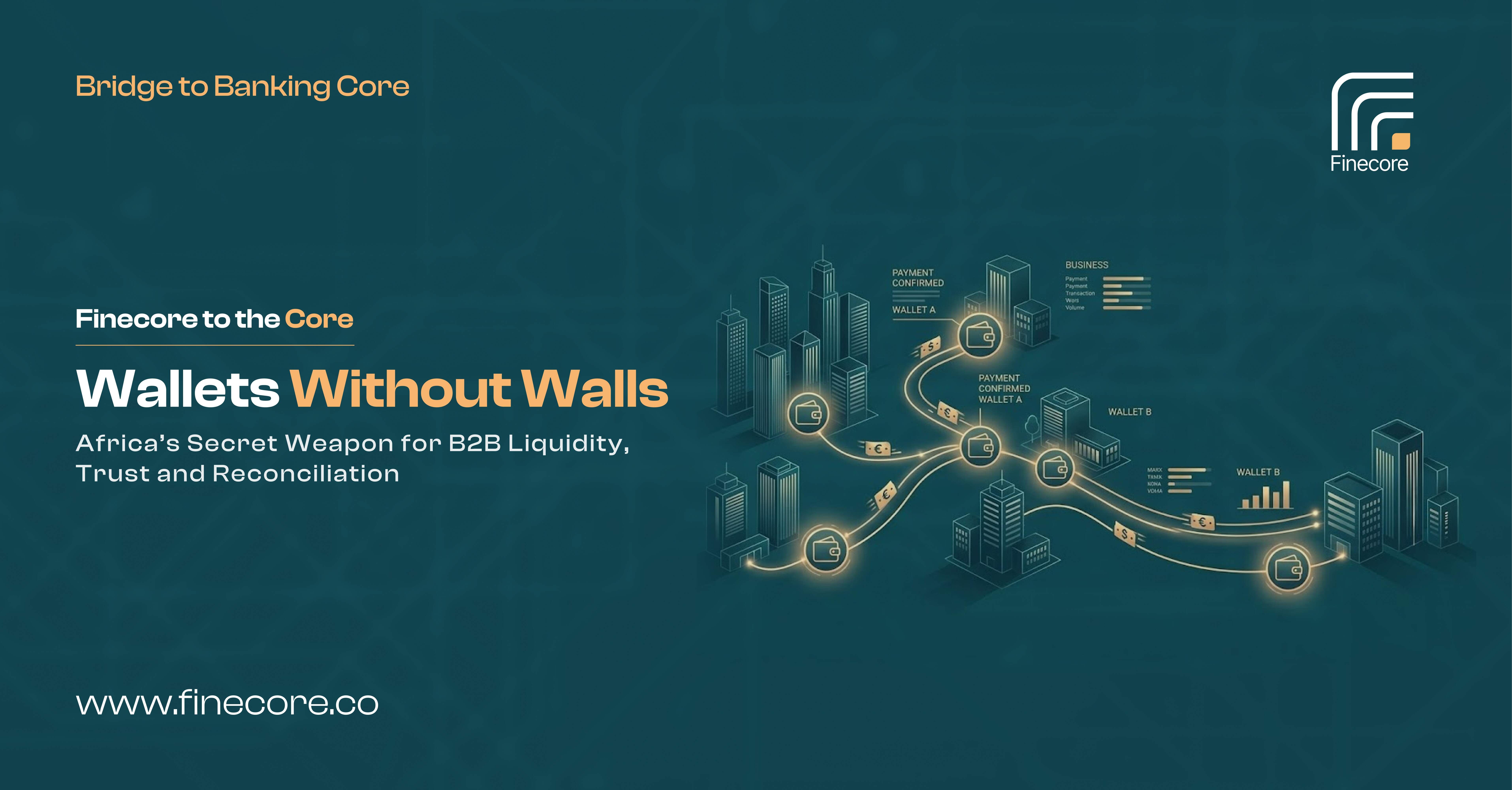
Wallets Without Walls: Africa’s Secret Weapon for B2B Liquidity, Trust and Reconciliation
You're a consumer (even if you're a founder, CEO, head of dept, or the wealthiest - you're still a consumer), and you live in an era of "instant." You can buy a drink in Lagos or a book in Nairobi and the transaction is settled before you’ve even taken your first sip or turned the first page.
But step into the world of B2B - where the real volume of African commerce lives - and "GBAM!" - You hit a wall. A thick, opaque wall built of 3-day settlement delays, manual bank statement reconciliations, and the "Trust Gap" that freezes liquidity.
When a wholesaler in Onitsha needs to pay a manufacturer in Guangzhou, or a logistics firm needs to settle with 500 independent drivers, they aren't just moving money. They are navigating a minefield.
At Finecore, we don’t see a "Wallet" as just a digital bag for money. We see it as the a very important and great tool for B2B survival. Keep reading to figure out why the "Wallet Without Walls" is the future of the African digital economy.
1. The Reconciliation Nightmare: From Days to Milliseconds According to recent industry data, African SMEs spend up to 15 hours a week manually reconciling payments. That is nearly two full workdays lost to matching "Bank Alerts" to "Invoices."
Traditional banking wasn't built for high-velocity B2B trade; it was built for static storage. Wallets Without Walls change the game by turning the payment into the data. When a payment hits a Finecore-powered wallet, the reconciliation happens at the ledger level, instantly. No more "Who sent this 50k?"
In 2026, the winner isn't the one with the most money; it’s the one with the cleanest data.
2. Solving the "Trust Gap" in Sub-Saharan Trade Trade in Africa is often slowed down by a lack of trust. “Send the money first,” says the supplier. “Send the goods first,” says the buyer. Liquidity freezes.
Embedded wallets act as a neutral "source of truth." By using programmable wallet infrastructure, businesses can create automated escrow-like environments. The money is visible, the trust is verified by the code, and liquidity flows. This isn't just a fintech feature; it’s a Trust Engine for the 44M+ underserved SMEs across the continent.
3. The Global Pivot: Stablecoins and B2B Liquidity We cannot talk about African B2B without talking about the "Dollar Problem." With the volatility of local currencies like the Naira, businesses are looking for "Walls" that don't block them from global trade.
We are seeing a massive surge in demand for Stablecoin Infrastructure. By embedding stablecoin rails into B2B wallets, Finecore allows businesses to hold value in a stable asset and settle borderless transactions instantly. This is how we move from "Regional" to "Global" without the 5% loss in exchange fees.
Why Speed is the Only KPI That Matters Most BaaS providers will tell you that building this infrastructure takes 6 months of development and a team of 20 engineers. They are wrong.
We built Finecore because we lived the "Time Barrier" firsthand. We realized that for an African business, a 6-month delay isn't just a nuisance - it’s existential. Our "Fine to the Core" philosophy means we’ve pre-built the compliance, the ledger, and the banking partnerships so you can launch Wallets Without Walls in 7 days.
Ready to bridge the gap? The infrastructure for the next generation of African B2B trade is ready. The question is: Are you still building walls, or are you building wealth?
Launch your B2B Wallet Suite in 7 days and get the Technical Blueprint: www.finecore.co Contact: [email protected]
Stay Fine to the Core.